Jagpal Singh All About Astronomy

Friday, 3 January 2014

Earth's Magnetic Field

Leave a Comment
Earth's magnetic field
Magnetic fields are produced by the motion of electrical charges. For example, the magnetic field of a bar magnet results from the motion of negatively charged electrons in the magnet. The origin of the Earth's magnetic field is not completely understood, but is thought to be associated with electrical currents produced by the coupling of convective effects and rotation in the spinning liquid metallic outer core of iron and nickel. This mechanism is termed the dynamo effect.

Rocks that are formed from the molten state contain indicators of the magnetic field at the time of their solidification. The study of such "magnetic fossils" indicates that the Earth's magnetic field reverses itself every million years or so (the north and south magnetic poles switch). This is but one detail of the magnetic field that is not well understood.

Structure of the Field

Magnetic field Lines

The field lines defining the structure of the magnetic field are similar to those of a simple bar magnet. It is well known that the axis of the magnetic field is tipped with respect to the rotation axis of the Earth. Thus, true north (defined by the direction to the north rotational pole) does not coincide with magnetic north (defined by the direction to the north magnetic pole) and compass directions must be corrected by fixed amounts at given points on the surface of the Earth to yield true directions.

The Earth's Magnetosphere


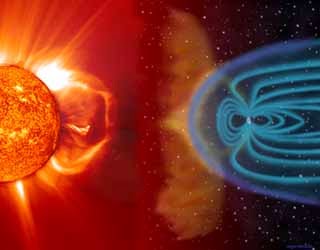
The solar wind is a stream of ionized gases that blows outward from the Sun at about 400 km/second and that varies in intensity with the amount of surface activity on the Sun. The Earth's magnetic field shields it from much of the solar wind. When the solar wind encounters Earth's magnetic field it is deflected like water around the bow of a ship.

Magnetosphere

The imaginary surface at which the solar wind is first deflected is called the bow shock. The corresponding region of space sitting behind the bow shock and surrounding the Earth is termed the magnetosphere; it represents a region of space dominated by the Earth's magnetic field in the sense that it largely prevents the solar wind from entering. However, some high energy charged particles from the solar wind leak into the magnetosphere and are the source of the charged particles trapped in the Van Allen belts.

Importance

The magnetic field of the Earth deflects most of the solar wind. The charged particles in the solar wind would strip away the ozone layer, which protects the Earth from harmful ultraviolet rays.

Humans have used compasses for direction finding since the 11th century A.D. and for navigation since the 12th century. Although the North Magnetic Pole does shift with time, this wandering is slow enough that a simple compass remains useful for navigation.
Read More...

Tuesday, 15 October 2013

Astronomical Distance Scales

Leave a Comment
Some Common Distance Units:
  • Light Year: the distance that light travels in one year (9.46 x 10^17 cm).
  • Parsec (pc): 3.26 light years (or 3.086 x 10^18 cm).; also kiloparsec (kpc) = 1000 parsecs and megaparsec (Mpc) = 1,000,000 parsecs.
  • Astronomical Unit (AU): the average separation of the earth and the sun (1.496 x 10^13 cm).
Some Common Distance Units
Some Representative Distances:
  • The Solar System is about 80 Astronomical Units in diameter.
  • The nearest star (other than the sun) is 4.3 light years away.
  • Our Galaxy (the Milky Way) is about 100,000 light years in diameter.
  • Diameter of local cluster of galaxies: about 1 Megaparsec.
  • Distance to M87 in the Virgo cluster: 50 million light years.
  • Distance to most distant object seen in the universe: about 13 billion light years (13 x 10^9 light years).
Logarithmic scale

 
Read More...

Monday, 14 October 2013

Hubble's constant (Hubble's Law)

Leave a Comment
The Hubble constant H is one of the most important numbers in cosmology because it may be used to estimate the size and age of the Universe. Hubble constant indicates the rate at which the universe is expanding. Although the Hubble "constant" is not really constant because it changes with time (and therefore should probably more properly be called the "Hubble parameter"). The Hubble constant is often written with a subscript "0" to denote explicitly (clearly) that it is the value at the present time, but we shall not do so. 

Hubble's Law


The Hubble Expansion Law


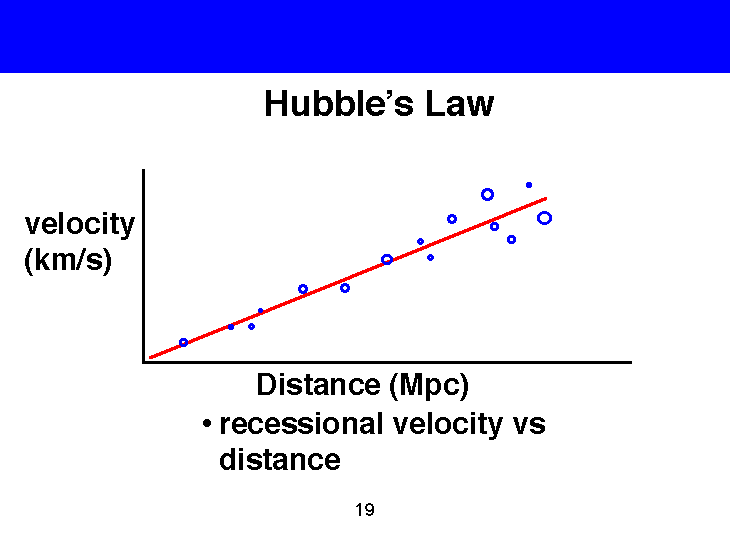
In 1929, Edwin Hubble announced that almost all galaxies appeared to be moving away from us. This phenomenon was observed as a redshift of a galaxy's spectrum. This redshift appeared to have a larger displacement for faint, presumably further, galaxies. Hence, the farther a galaxy, the faster it is receding from Earth. The Hubble constant is given by
H = v/d
where v is the galaxy's radial outward velocity, d is the galaxy's distance from earth, and H is the current value of the Hubble constant.

Redshift & Blueshift
(Note -  In physics, redshift happens when light or other electromagnetic radiation from an object moving away from the observer is increased in wavelength, or shifted to the red end of the spectrum. In general, whether or not the radiation is within the visible spectrum, "redder" means an increase in wavelength – equivalent to a lower frequency and a lower photon energy, in accordance with, respectively, the wave and quantum theories of light. Redshifts are an example of the Doppler effect.)


Determining the Hubble Constant


Obtaining a true value for H is complicated. Two measurements are required. First, spectroscopic observations reveal the galaxy's redshift, indicating its radial velocity.
Determining the Hubble Constant
The second measurement, the most difficult value to determine, is the galaxy's precise distance from Earth. The value of H itself must be derived from a sample of galaxies that are far enough away that motions due to local gravitational influences are negligibly small (these are called peculiar motion, and they represent deviations from the Hubble Law).

Units for Hubble's Constant


The units of the Hubble constant are "kilometers per second per megaparsec." In other words, for each megaparsec of distance, the velocity of a distant object appears to increase by some value. For example, if the Hubble constant was determined to be 50 km/s/Mpc, a galaxy at 10 Mpc would have a redshift corresponding to a radial velocity of 500 km/s.


Current Value of the Hubble Constant


The value of the Hubble constant initially obtained by Hubble was around 500 km/s/Mpc, and has since been radically revised because initial assumptions about stars yielded underestimated distances. For the past three decades, there have been two major lines of investigation into the Hubble constant. One team, associated with Allan Sandage of the Carnegie Institutions, has derived a value for H around 50 km/s/Mpc. The other team, associated with Gerard DeVaucouleurs of the University of Texas, has obtained values that indicate H to be around 100 km/s/Mpc.

Current Value of the Hubble Constant


Read More...

Wednesday, 21 August 2013

What are the smallest particles in the Universe?

Leave a Comment
These smallest particles fall into several main categories, most notably fermions, hadrons and bosons.
For many years, the only known subatomic particles were protons, neutrons and electrons. By the 1960s, however, advancements in particle accelerator technology had shown evidence of hundreds of smaller constituent particles. By studying these particles -- all part of what is known in particle physics theory as the standard model -- physicists can try to explain all of the forces and matter existing in the universe.

These smallest particles fall into several main categories, most notably fermions, hadrons and bosons.


Fermions


Fermions are the building-block particles. There are two types of material fermions: quarks, which work to hold the nucleus of an atom together, and leptons, which do not. Fermions can be broken down even further: There are different types of quarks, and for each, an anti-quark. Quarks are found in groupings, but leptons are found alone. Electrons and neutrinos are examples of leptons. Fermions have a half-integer spi.

Hadrons


Hadrons are composite particles made of smaller particles. A proton, for example, is a hadron made from a combination of different quarks. Strong interactions bind the hadrons together and they always have charges, but no color. Protons and neutrons are the most stable hadrons. Hadrons come in two classes: baryons and mesons.

Quarks


Quarks are the fundamental constituents of hadrons and interact via the strong interaction. Quarks are the only known carriers of fractional charge, but because they combine in groups of three (baryons) or in groups of two with anti-quarks (mesons), only integer charge is observed in nature.

Leptons


Leptons do not interact via the strong interaction. Their respective antiparticles are the anti-leptons which are identical except for the fact that they carry the opposite electric charge and lepton number. The antiparticle of the electron is the anti-electron, which is nearly always called positron for historical reasons. There are six leptons in total; the three charged leptons are called electron-like leptons, while the neutral leptons are called neutrinos. Neutrinos are known to oscillate.

Bosons


Bosons are subatomic particles that carry force. They help particles interact with one another without touching, much like the forces of gravity or magnets. Unlike fermions, bosons have integer spin. The Higgs boson is believed to be the tiny particle that likely provides mass to all matter. Yet scientists aren't even sure that the Higgs boson exists.The Higgs boson remains one of the key questions remaining in physics and in wrapping up the Big Bang theory. If scientists can identify and study the particle that gives mass to all others, they can explain how the universe started from a seemingly invisible field.


Read More...

Monday, 5 August 2013

Astronomy - August 2013 (40th Anniversary Issue)

Leave a Comment
Astronomy - August 2013 (40th Anniversary Issue)

Look forward to studying the starry night sky? Revel in seeing if you can locate and connect the Big Dipper and the brightest North star? If you're a star gazing enthusiast, you'll love Astronomy. You'll learn more about exploring the universe in your own backyard with the most popular amateur astronomy magazine.

  • Astronomy - August 2013 (no ADS) 40th Anniversary Issue
  • English | PDF | 83 pages | 36.6 MB
FEATURES :-
  • 26 COVER STORY - 40 greatest astronomical discoveries
  • Astronomers' biggest breakthroughs have lifted the veil on our universe. RICHARD TALCOT T
  • 32 40 greatest mysteries of the universe
  • Astronomers know more about the universe than ever but still have much to learn. SARAH SCOLES
  • 38 Where will astronomy be in 40 years?
  • The future involves larger collaborations, computers, and telescopes. DEBRA MELOY ELMEGREEN AND BRUCE G. ELMEGREEN
  • 44 The Sky this Month
  • Neptune's summer surge. MARTIN RATCLIFFE AND ALISTER LING
  • 46 StarDome and Path of the Planets
  • RICHARD TALCOTT; ILLUSTRATIONS BY ROEN KELLY
  • 52 40 years of amateur astronomy
  • We live in our hobby's golden age - just look at what's happened in the past four decades. MICHAEL E. BAKICH
  • 58 Astronomy magazine's path to "stardom"
  • From its modest beginnings, the publication now leads the astronomy hobby as the most
  • popular magazine of its kind in the world. DAVID J. EICHER
  • 68 Ask Astro
  • Refracting light.
  • 70 40 deep-sky targets in Sagittarius
  • The Archer contains a dizzying variety of dazzling objects. MICHAEL E. BAKICH
  • 72 Hunt down summer's best dark nebulae
  • For a totally new observing experience, ignore the bright and aim for darkness. MICHAEL E. BAKICH
  • 76 A backyard imager advances science
  • An unexpected email opened the door for this astroimager. R. JAY GABANY
  • 80 Prime time for Neptune and Uranus
  • Late summer and early fall are the best times to track down the solar system's distant planets. RICHARD TALCOTT
COLUMNS :-
  • Strange Universe BOB BERMAN 11
  • Observing Basics GLENN CHAPLE 14
  • Secret Sky STEPHEN JAMES O'MEARA 18
  • Cosmic Imaging TONY HALLAS 24
QUANTUM GRAVITY :-
  • Snapshot 9
  • Breakthrough 10
  • Astro News 12
IN EVERY ISSUE :-
  • From the Editor 6
  • Letters 11, 18,24
  • New Products 84
  • Web Talk 84
  • Advertiser Index 87
  • Reader Gallery 88
  • Final Frontier 90
Read More...